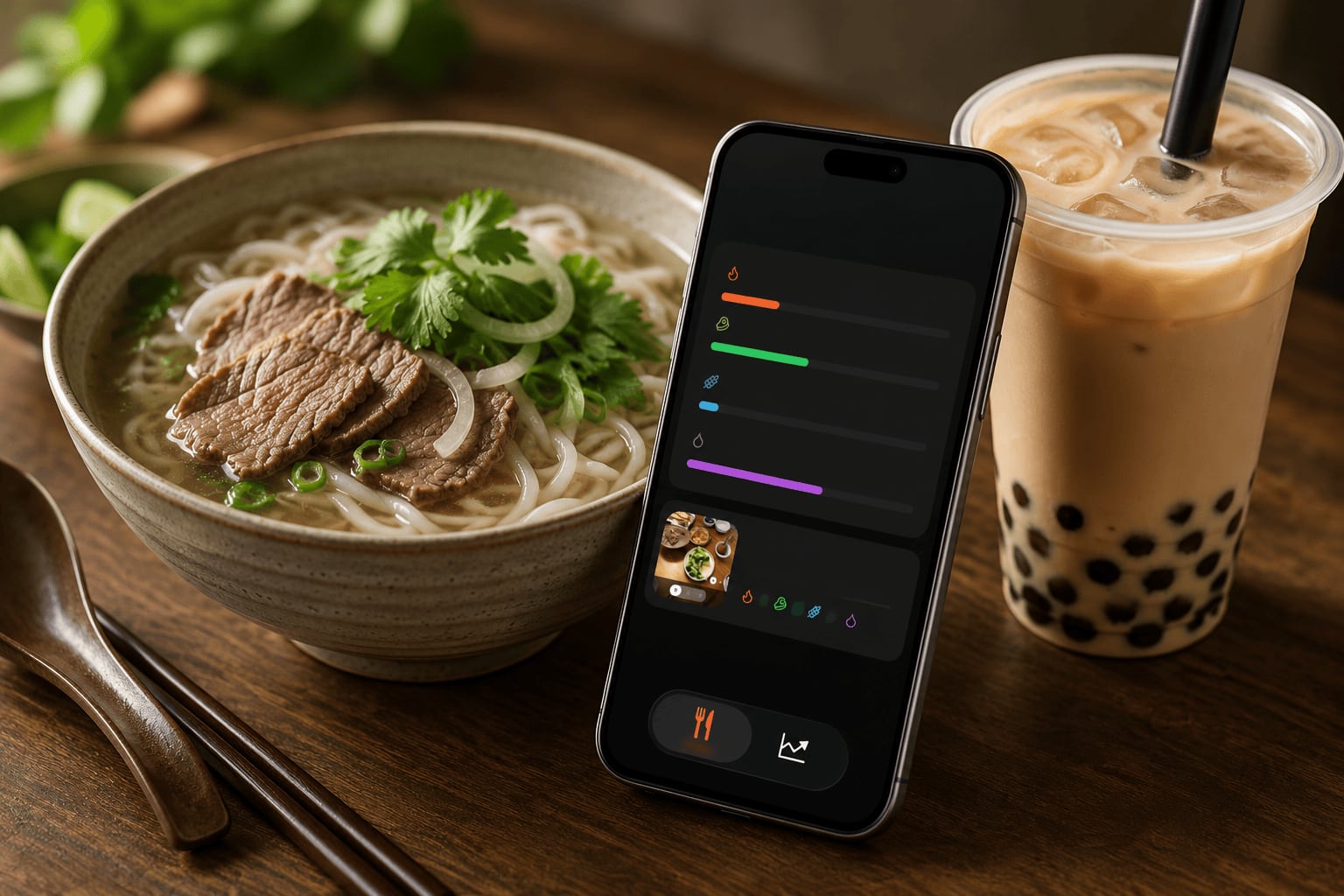
In August 2024 a research team at the University of Sydney published a paper in Nutrients. They tested 18 AI calorie tracking apps on real food. The apps overestimated beef pho by 49 percent. They underestimated pearl milk tea by up to 76 percent. Manual calorie tracking apps did roughly the same kind of damage in the other direction, undercounting Asian diets by about 1,520 kilojoules a day. That is around 360 calories the user never logged.
If you eat the way most of the world eats, around a table, sharing dishes, ordering for everyone, you have probably already noticed something in this neighbourhood. You scan a hot pot and the app labels it "mixed soup." You photograph a thali and it lists six things, none of them right. You give up halfway through dinner and log lunch as "rice."
That gap is what Before I Bite is built around: shared meals, editable portions, and estimates you can correct before saving.
What the Sydney study found
Li and colleagues at the University of Sydney did not chase obscure dishes. They picked common Asian meals: beef pho, pearl milk tea, fried rice, dumplings, the breakfast plates that turn up every morning across half the world. Then they ran them through 18 AI calorie tracking apps and compared the output to verified nutrition references.
The numbers were not subtle.
- Beef pho: AI calorie estimates were about 49 percent too high on average.
- Pearl milk tea: estimates ran up to 76 percent too low.
- Manual logging apps, the alternative most people fall back on, undercounted Asian diets by roughly 1,520 kilojoules per day.
The paper's title puts the problem in academic language. The conclusion is more direct: AI nutrition apps need to do better with cultural diversity. In plain English, if your meal does not look like a single American plate, the math falls apart.
Why this happens
The AI is doing the thing it was trained to do. The training is the issue.
Three things drive the gap.
The first is that the training data is heavily weighted toward Western food. The most cited public dataset in this space is Nutrition5k, assembled by Google Research. SnapCalorie used it for a CVPR 2021 paper showing about 15 percent mean caloric error, which is genuinely strong work on that dataset. It tells you very little about how the same model performs on a thali, a mezze platter, or a hot pot, because Nutrition5k was collected in the United States.
The second is that the training images show one person, one plate, photographed from above. None of that resembles the way a hot pot, a mezze spread, or a Korean BBQ table actually looks. The model has never been shown the meal it is being asked to identify.
The third is that the food databases under these AI systems are submitted by users and skewed Western. MyFitnessPal's database holds about 20 million entries, and a JMIR validation study found macronutrient errors of 8 to 17 percent on the verified ones. The unverified entries, which are the majority, are notoriously inconsistent. If the database has no clean entry for Hainanese chicken rice or South Indian thali, the AI guesses based on the closest Western analog. That is not the same as accuracy.
These are not bugs waiting for a patch. They are properties of the training distribution. Closing the gap takes a different dataset and a different design.
The recent consolidation
In the 13 months before this post, the AI nutrition tracking market consolidated hard, and consolidated entirely around the same individual plate paradigm.
In February 2025, MyFitnessPal acquired Intent, an AI meal planning startup. In January 2026, MyFitnessPal launched a ChatGPT Health integration as one of OpenAI's launch partners. In March 2026, MyFitnessPal acquired Cal AI, the dominant AI photo calorie app, with roughly $40M in revenue at the time of the deal. Cal AI was built by a group of US teenagers and now runs on top of MyFitnessPal's database.
By feature count, MyFitnessPal now has the broadest AI nutrition surface of any tracker on the market. By cuisine coverage, the consolidation changed almost nothing. None of the announcements around any of those three deals mention shared meals, family-style splitting, or cuisines outside the West. The AI got better at doing the thing it was already good at.
What this looks like at a real table
Pick a few common shared meals and ask what an AI calorie app actually has to do.
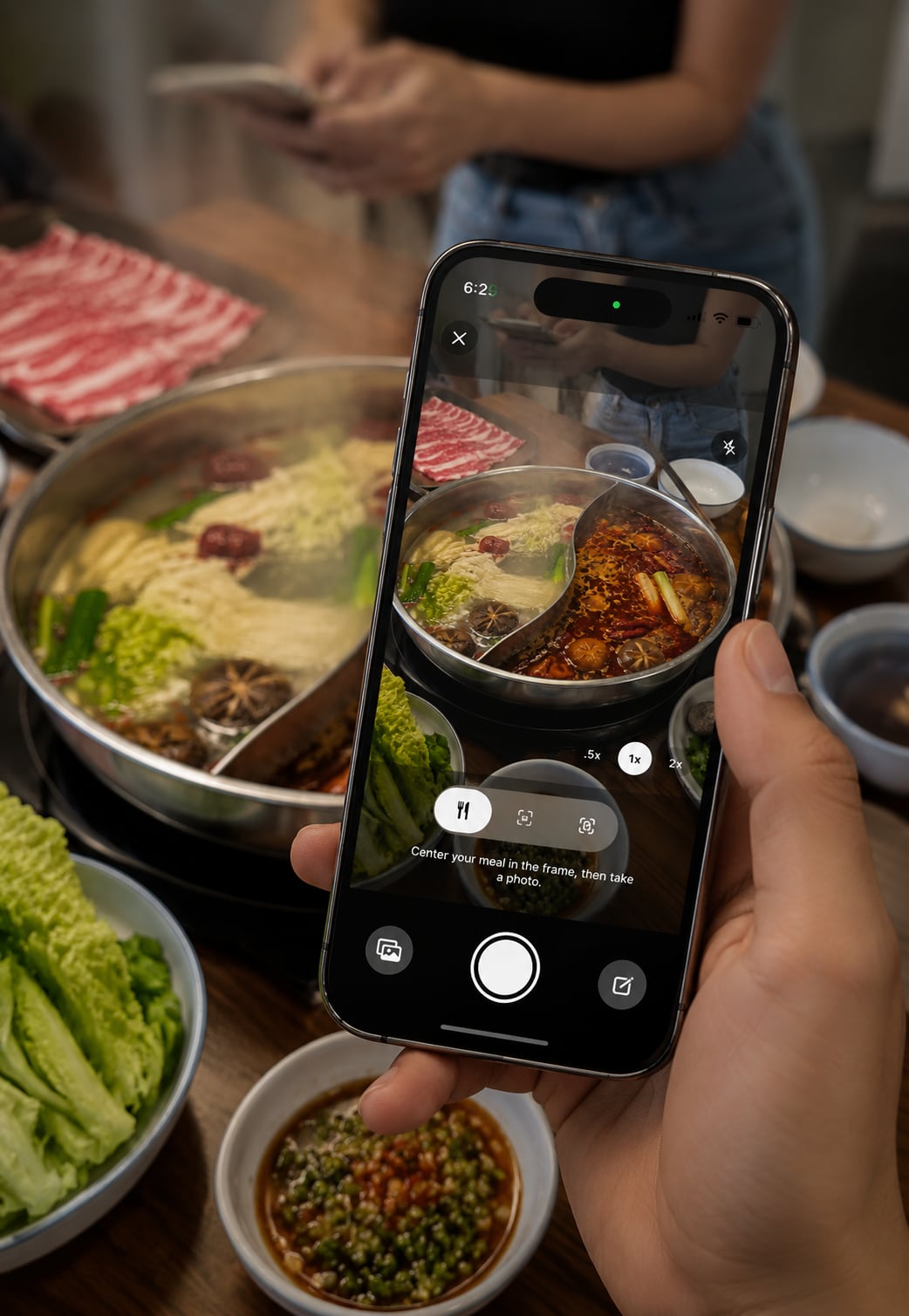
A hot pot. A communal broth at the centre of the table. People drop in beef slices, fish balls, leafy greens, tofu, noodles throughout the meal, and pull out whatever they want. Your portion is whatever you actually ate, which no single photo can tell anyone.
A mezze platter. Ten or twelve small plates, four people, a couple of hours. Hummus, baba ghanoush, tabbouleh, fattoush, kibbeh, falafel, labneh, olives. People reach. The amount you ate of the labneh is not the amount your sister ate.
A South Indian thali. Six or more items on one tray. Rice, sambar, rasam, two or three vegetable curries, a dal, yoghurt, a sweet. Each portion sized differently depending on the kitchen and the region.
Tapas. A dozen small plates passed around for five people across an evening. Patatas bravas, croquetas, jamón, gambas, tortilla.
Korean BBQ at the table. Raw meat grilled in front of you, banchan shared across the table, the cut and the quantity varying by who reaches for what.
A family-style stir fry. One wok, four people, a stack of rice bowls, everyone serving themselves.
None of those meals match the "one photo, one plate, one person" model the AI was trained against. So the dish guesses come back vague: mixed soup, Asian plate, stew. The portion guesses come back as the whole pan, when you actually ate a quarter of it. The Sydney percentages are the average. At a real table the user experience error is even worse, because the AI cannot even name the meal correctly, and the user gives up before logging the rest of dinner.
What "free" actually means in 2026
Sitting on top of the accuracy gap is a second issue. The features that make AI calorie tracking useful, photo recognition and barcode scanning, are increasingly paywalled in the leading apps.
| App | AI photo | Barcode | Annual price |
|---|---|---|---|
| MyFitnessPal Premium | Premium only | Premium only | $79.99 |
| Lose It! Premium | Premium only | Premium only for new users | $39.99 |
| Cronometer Gold | Gold only | Free | $59.88 (Gold) |
| SnapCalorie | Limited free | Free | Free tier |
Cronometer is the unusual case. Barcode scanning is genuinely free, but AI photo sits behind the Gold tier. Across the rest of the category, the AI you would actually want to log a shared meal with costs $40 to $80 a year to reach. And then it does not work on the meal you are trying to log.
(Pricing was current as of May 2026. Verify against each app's current public pricing before quoting these numbers anywhere downstream.)
What we are building Before I Bite around
We are not claiming perfect accuracy. The Sydney study is the honest baseline for what AI nutrition recognition can do in 2026, and any app, including ours, should treat AI output as an estimate the user can correct.
What Before I Bite is built around is a different premise.
The shared table is the default unit, not the individual plate. You can split a shared dish between the people sharing it and adjust each person's portion in seconds, without logging the meal again from scratch.
The cuisines mainstream trackers consistently miss are the ones we lead with. Hot pot, dim sum, mezze, thali, tapas, paella, injera, churrasco, family-style stir fry, Korean BBQ. The product is designed around those meals as primary cases, not as a footnote to the American salad bowl.
AI photo, barcode, and label scanning belong in the core workflow. Before I Bite includes all three in every plan — free with ads, or ad-free with Pro — so no capture method sits behind a separate paywall.
AI output is editable. Estimating is hard. Correcting an estimate should not be. Tap the food, change the quantity, save.
The Sydney study is not our marketing copy. It is the gap we are trying to close.
What to look for in any AI calorie tracker
If you are evaluating AI nutrition apps right now, ours or anyone else's, here are the questions worth asking before you commit.
Does the AI return a specific dish name or a vague "mixed plate"? Specificity tells you the model has seen this kind of food before.
Can you split a dish across the people sharing it without logging the whole meal again? Most major AI trackers cannot.
Can you adjust an ingredient's quantity instantly? Shared meals do not arrive in fixed portions. Editing has to be quick.
Are AI photo and barcode actually included in the plan you are buying, or are they separate upsells? Read the App Store page carefully.
Is the training data declared, or just claimed? "95 percent accurate on global cuisines" with no citation is marketing copy, not evidence.
The honest answer in 2026 is that no tracker, including ours, has solved shared meal nutrition AI. The work is closing the distance between an app designed for an individual American plate and an app designed for the table. That gap is what the whole category needs to close, and we are not the only ones who should be trying.
Ready to try it? Download Before I Bite on the App Store.
Read next:
- How to track a hot pot when you do not know your portion (coming soon)
- Logging a thali when six dishes share a tray (coming soon)
Sources: Li, X. et al. (2024). Full paper in Nutrients, August 2024. MyFitnessPal acquires Cal AI: TechCrunch, March 2026. Pricing figures from MyFitnessPal, Lose It!, and Cronometer public pricing pages as of early May 2026.